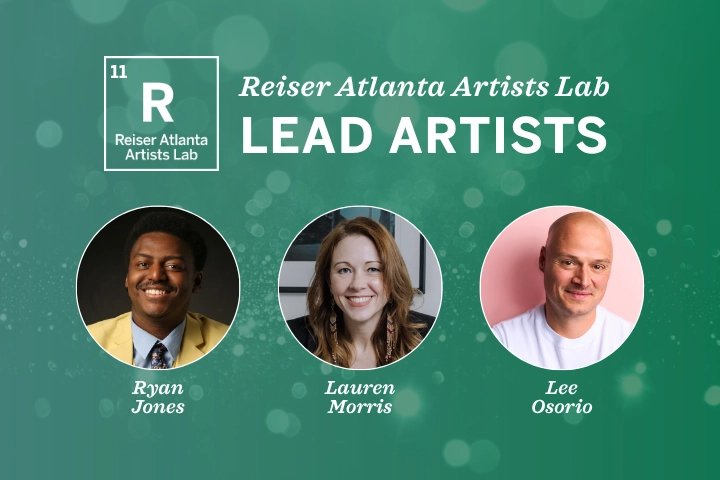
The Reiser Atlanta Artists Lab creates dedicated space for Atlanta artists to create a piece of new work over the course of a year. For eleven years, three projects have received $10,000 to fund their piece’s development, along with rehearsal space and artistic mentorship provided by Alliance artistic staff.
With the support of Alliance Theatre, the Round 11 cohort of Reiser Lab artists developed their idea with a group of collaborators, resulting in a final presentation of their works-in-progress. This year’s Reiser Lab Festival is May 1-3, 2026 on the Hertz Stage. Read more about the Reiser Atlanta Artists Lab Round 11 projects and their lead artists below. For more on the program, check out the Reiser Atlanta Artists Lab page.
These interviews have been edited for length and clarity.
What inspired your piece? Why this story? Why now?
Ryan Jones: I started writing in spite of years of silence in 2018, where I was navigating through feelings that I had about my childhood; however, […]I couldn’t find a resolution to the work… So, I put it down to be picked up again later. 7 years later, I had resolved my feelings, become a father myself, and found myself wanting to reapproach the work and externalize that resolution and my new perspective.
It also became evident, at the same time, with the war being waged on diverse narratives (particularly those that involved Black people and their families), that this was a story that needed to be shared with the world, and not one that just languished in my Google Drive. I believe Black people and Black families to be beautiful. I believe Black narratives to be beautiful. And I believe that this choreopoem does the work of both interrogating and celebrating them… and I think we need more of that right now: the celebration of diverse people, their voices, and their perseverance in spite of the world.
Lee Osorio: Our Confederate Dead was inspired by two things. The first is a Confederate memorial, a large white obelisk in Oakland Cemetery. It stands over a sleeping lion statue that represents the Confederacy- which is sleeping and will wake again. The obelisk says, “Our Confederate Dead.” I walk in Oakland regularly, and the use of the word “our” has always struck me. How much ownership do I have over those Confederate dead? And is the Confederacy actually dead, or merely sleeping as the lion statue implies.
The second inspiration was how many Latinos, including members of my family, voted for Trump. So much of the ideology of the MAGA movement echoes that of the Confederacy. It made me think that maybe my community has more ownership of those dead than I want to admit.
Lauren Morris: I was inspired to explore a story idea that the playwright Catherine Stewart had shared with me several years back, for a play (Threads) that questioned how we discard women as they age, that was also set in the fashion industry–a place where we also overlook the (often female) laborers who make our clothes, and then we also all too quickly discard the clothes themselves. I was excited to investigate all of this through an ensemble-centered devising process, so for us, it wasn’t only about the story but about the people in the room–the characters evolved out of physical theatre techniques, actor-improvised hot-seating exercises, and the specific ethnic, racial and cultural identities of the actors playing them.
As our world is increasingly technologically connected, it seems all the more important to create work about the human toll of our actions; stories that connect us to the human beings behind machines and industry. And I am most interested in making that work in a collective ensemble, which can be messy and tricky and complex, exactly because it embodies those all too human traits.
What has this process been like for your team?
Ryan: Developing this piece has been both a trial of stamina, and a whirlwind of joy. Writing […]this script has been a challenge in so many ways, but borne out of it has been this immense joy that my team and our cast bring to this work. Kirsten is electric in the rehearsal space, and her leadership really makes the process both organized and fun. Tadiwa is an enthusiastic collaborator and has worked hard to fill in the gaps, and has brought the additional energy we’ve needed to tackle the work. And the cast! They’re all fantastic artists and a joy to work with. Working on this project has been a dream. Secretly, it makes me worried that I’ll be chasing this moment for the rest of my life… but that’s a problem for future Ryan.
Lee: A rollercoaster. I applied with the idea and some early pages, but the process has gone in a very different direction. I thought this was a multi-actor play, but it has become a solo show. Lilliangina and Maria were so helpful in the process of figuring out what the form of this piece was, but as it took shape we’ve ended up in a completely different place.
Lauren: It has been a really great proving ground for things we wanted to try. We forced ourselves to really focus on process and not on the final result, especially in the earlier months of the lab, and that was more challenging than I expected it to be. We are all so conditioned to push to a product, but the gift of the Reiser Lab is that it is for development. So we learned to get comfortable with the uncertainty of what the play would look like when we got to May, and kept our minds and bodies in the building of the world for as long as possible. I would say that for me, watching the physical devising work develop directly into character and relationship in the text was tremendously satisfying.
What is the most meaningful part of being an artist in Atlanta?
Ryan: One of the most meaningful parts of being an artist in Atlanta is being a part of a community of artists across multiple disciplinaries who want nothing more than to create impactful and transformative work that leaves the world changed.
Lee: There are so many rich stories here- in Atlanta and in the South- that haven’t gotten the attention they deserve. If I lived in New York, I don’t know what I would write about because I feel like that place has been mined for all its stories. But here, around every corner there is new inspiration. And there is space and energy to make here. It’s still somewhat affordable to do so. Whether there is the audience to support new and challenging work, I don’t know, but it’s a place where it’s possible to produce it.
Lauren: I find a lot of meaning in the long-term artistic relationships that can develop when you make art in the place that is your home. I love being able to grow as an artist alongside my collaborators. I love working with people who know me deeply and can understand my shorthand, as well as working in a city that’s large and diverse so that I can also constantly learn from new collaborators. This Reiser Lab year has been a perfect microcosm of that. It has allowed me to deepen artistic relationships I already have as well as create strong new ones.
How has the Reiser Lab helped to support your development as an artist? Your team?
Ryan: The Reiser Lab has challenged me to see my work in new ways and to be open to starting over. So much of this development journey has been about starting over. So much about the work itself is about starting over. It feels like an appropriate to me that one of my largest takeaways has been that it’s okay to start over when something (be it a script, experience, or dynamic) isn’t servicing you in the way that you need it to. I think this process has also helped me (and my team) challenge our conceptions of the word “collaboration.” I think, through this process, we’ve really defined what collaboration looks like to each of us, and what our expectations are when collaborating with one another.
Lee: Amanda Watkins, Abrianna Belvedere, the cohort of Reiser Artists have been so supportive, as have all the staff at the Alliance. That support is so important for emerging artists because so often we spend months and months writing, and we don’t know if what we’re spending all this time doing is any good or if anyone cares. Having someone say, “There’s something here. Keep going.” That is often the only thing stopping someone from giving up right before they birth something beautiful. Every artist needs those doulas to say, “Keep pushing. I know it’s hard, but keep pushing. You’re almost there.”
Lauren: The opportunity to dream big and focus on the process has been priceless. [The Reiser Lab] has been an excellent proving ground for me to integrate physical devising techniques into my practice as a director. I have also learned so much about the way I want to conduct ensemble-based work.
What’s next?
Ryan: I will be campaigning to mount a full production of this work, as I truly believe that it has legs and will walk–run, even–if given the opportunity. Outside of that and performing, there are some ideas I have for new work that I’ll be starting soon!
Lauren: I think we will continue to develop Threads through workshop processes over the next months, and then we’ll see! I don’t think this is the end of its development, and we will be excited to integrate audience feedback after we share it on May 1st.
Lee: What a question. These days I try to focus on what I have to do today. Be honest. Love as best I can. Meet people where they are. Hope they do the same.
What are your hopes for the future of the Atlanta arts community?
Ryan: I hope that the future of the Atlanta arts community is one where everyone has the opportunity to sit at the table. I think there is so much work that needs to be done to ensure that everyone is aware of the opportunities that are available to them, and to make sure that fresh, new artistic projects are funded… I aim to take part in making sure that happens.
Lee: My hope is that we become scrappier. I want Atlanta to embrace our limitations. Do art in weird spaces, create work where the lack of money leads to bold, imaginative design, art that is more of an event. We’ve gotten safe. We’ve gotten palatable, polite. I think we’ve gotten scared of people not coming. I remember when there was nasty art in Atlanta theatre. I hope we get nastier. Not mean, not foul for the sake of foulness, but gleefully, boldly human. And y’all, humans, if you’ve never met one, they are nasty creatures. In the best way.
Lauren: I hope we can be more connected as a sector. I want to be a part of an arts ecosystem here in Atlanta that supports artists not just making art, but also making a sustainable living as artists. Through more connection, not just across the theatre community, but across disciplines, we can start to talk about, and then address, the barriers that currently exist for professional art-makers here. We can also identify what’s working well and amplify those things. Programs like the Reiser Lab do help to move that needle, by challenging artists to create ideas for new projects with the call for entries, and then connecting the selected cohort throughout the year.
Describe your project in 3 words.
Ryan: Experimental. Courageous. Inspiring.
Lauren Morris: Legacy. Retribution. Resilience.
Lee Osorio: See for yourself.
The Reiser Atlanta Artists Lab is sponsored by Margaret and Bob Reiser.