
An act to execute certain treaty stipulations relating to the Chinese, May 6, 1882; Enrolled Acts and Resolutions of Congress, 1789-1996; General Records of the United States Government; Record Group 11; National Archives Large
In the early to mid-19th century, gold was discovered in California, the railroad industry was booming, and Great Britain’s illegal exportation of opium into China soon led to the Opium Wars. These conflicts, famine, and destabilization severely impacted China’s economy, particularly in the Guangdong region, where Afong Moy was born. Many Chinese laborers left their home to find work in the burgeoning industries of the American West. American companies, prohibited from using enslaved labor in the Free territories, exploited Chinese immigrants by offering low wages and imposing long work days.
Chinese immigrants faced pervasive xenophobia, racist articles, and propaganda depicting Chinese immigrant communities as unclean, drug-addicted, or otherwise threats to American values. In 1854, the California Supreme Court case People v. Hall ruled that testimony from Chinese people against the White people was inadmissible. The ruling held that Chinese people were “a race of people whom nature has marked as inferior.” This decision effectively legalized violence against Chinese Americans, resulting in a surge of under-legislated hate crimes.
Racism and xenophobia exploded into the LA Chinatown Massacre of 1871, triggered when a police officer was wounded and a saloon owner died during a shootout between two rival Chinese criminal organizations. During the massacre, a mostly White mob lynched nearly 10% of the Chinese American population in Los Angeles. All convictions brought against the mob were overturned on technicalities. A few years later, The Page Act banned the importation of forced laborers and sex workers from any nation in Asia; its enforcement relied on the sexualization and fetishization of Asian women. The Page Act was enforced in a way that aligned all Chinese women with sex work, and immigration officials were given full authority to bar Chinese women from entering the United States. In 1877, the Workingmen’s Party of California, a racist labor organization, was founded with the goal of eradicating Chinese laborers from America, espousing the slogan, “the Chinese must go.”
In 1882, the United States passed the Chinese Exclusion Act, the first immigration bill to explicitly ban a specific race or nationality. This act banned all Chinese people from entering America with few exceptions.
During the Exclusion era, the nearly 110,000 Chinese Americans who immigrated before 1882 were denied naturalization, barred from owning land, and prohibited from interracial relationships.
In 1885, a White mob razed the Chinatown in Rock Springs, Wyoming, forcing over 600 Chinese residents to flee and killing at least 28, though the actual number of deaths may have been higher. The 1887 Hell’s Canyon Massacre resulted in the deaths of 34 Chinese gold miners. The site was renamed “Chinese Massacre Cove,” and the memorial sign reads: “No one was held accountable.”
The Chinese Exclusion Act was not repealed until 1943; even then, only 105 visas per year were given to Chinese immigrants. It wasn’t until 1965 that the quota was increased to 20,000. The legacy of Exclusion-era policies and racist rhetoric continues to affect Chinese Americans today. Hate crimes against Asian Americans increased during the COVID-19 pandemic, fueled by the same stereotypes that led to the Chinese Exclusion Act. In 2021, the Atlanta Spa Shootings were a targeted attack against Asian women, the tragedy connected to the dehumanization and sexualization of Asian women that resulted in the Page Act of 1875.
Right now. Right here. In 2024, it is our responsibility to listen to the voices of Asian Americans, amplifying them over the harmful narratives and tropes that originated in the Exclusion era and undoing the legacy of harm caused by the enactment of the Chinese Exclusion Act.
Special thanks to Tom Zhang, Visiting Assistant Professor at the University of Kansas, theater-maker, actor, and one third of the Atlanta Theater Collective You Should Feel Bad for their consultation on this article. Tom is dedicated to creating performances that use humor to explore race relations and American identity. You can learn more about their work at thetomzhang.com.
Performances of The Chinese Lady will take place on the Hertz Stage, September 18 – October 13, 2024.

Playwright Lloyd Suh
The challenge of writing a play based on a historical figure is already quite a feat, but this challenge increases exponentially when the figure has very little historical record.
When playwright Lloyd Suh first heard of Afong Moy, her story haunted him.
“I did a deep dive of trying to find out as much as I could about her,” Suh says, “not because I wanted to write a play but simply because I needed to understand her story even just on a personal level. But you can only go so far in a deep dive — not only does the historical record completely ignore her after a point, but there is absolutely nothing on record that comes from her point of view.”
He did as much research as possible, given the circumstances, but had to put the writing process on hold for a while to focus on writing other plays.
Suh was a “pretty intense reader” when he was young, so he learned early on that he was interested in writing, specifically novels. This became clearer in high school, so he majored in English with a concentration in writing creative fiction.
“Theater came later,” he says. “I had a bunch of friends who were actors or theater majors, and they always seemed to be having so much fun. So I started spending more and more time at the theater department, and the vibe in that building was something I was really craving.”
Suh has written many plays, but Atlanta audiences may be familiar with his work Bina’s Six Apples, a part of the Alliance’s 2021/22 Season and a coproduction with Children’s Theatre Company.
“Bina’s Six Apples,” he says, “was a play for young audiences, has a larger cast, wildly different setting — but is also similar [to The Chinese Lady] in that it’s deeply rooted in history and is concerned with a young person navigating the tumult of history towards a sense of self-actualization. I’ve written about history a lot over the past several years, and while the plays are all very different in terms of form and content, they are definitely in conversation with each other.”
When Suh eventually returned to Afong and the play he was crafting around her, he realized that he didn’t want to start deviating too much from her actual life.
“I was, of course, deeply reverent of [Afong] and her history,” Suh says, “so I knew I didn’t want to just start making things up. So I put the play away. I didn’t think I could finish. But I couldn’t stop thinking about it, and the more I thought about it the more I realized that the only way forward was to make the second half of the play about that mystery — it was about the absence of her, and what it means for us to understand that absence.”
“The real Afong Moy is completely unknowable. The Afong Moy of this play therefore differs from the historical Afong Moy entirely, except that she is similarly unknowable.”
Crafting a story takes on an entirely different level of skill when a playwright wants to stay as true to the original history as possible while still filling in the blanks with supposals of what might have been. For Suh, filling the blanks with supposals is “partially an exercise in aspiration.” Instead of focusing on the characters or the historical aspect or the writing itself, Suh thought of the actors and framed it as “a conjuring.”
“I could never have done any of this if I had carried the weight of history and the obligation of trying to accurately represent her legacy through just text,” says Suh. “There is an aspect of Afong Moy’s story that resonates in a very specific and personal way with actors — this became very clear to me the second I put any of these words in front of actors in a room. So I started there. I thought about the text as a map or a blueprint, to allow actors to conjure an aspirational Afong Moy within their own personal experience, commune with that history, and contemplate what her absence means for how we honor the past, not just in the present but in the future.”
There’s a moment part of the way through the play where Afong has a shift. The ability for actors to conjure their own version of her from within their own personal experience, sadly, may not be that far of a reach.
“It’s happened to all of us,” says Suh, “sometimes often, in various intensities. … Moments in a conversation, or a friendship, or a relationship, or a job or anywhere, where you suddenly realize that you’re being perceived not as yourself but as an ornament of assumptions that come purely out of how you present to the world. It’s a moment of fear and shock and can be deeply dehumanizing, but I’m also interested in how it can be a moment of profound growth.”
Suh has been able to see several very different audiences respond to his play in very different ways. He says that because The Chinese Lady speaks directly to today’s theatrical audiences, “it’s a play that allows — even requires — an audience to respond personally.”
“The cultural moment in which the play was written was very different than the cultural moment now,” he says. “Very different than it was during the pandemic, in the aftermath of the murder of George Floyd and our national reckoning around history and race, after the Atlanta spa shootings. … I hope [audiences] respond personally, and with all of these moments in contemporary history as a part of their accounting of what it means in synthesis. … I want everyone to have a personal reaction, and it’s especially meaningful if it comes fully out of their own personal history, their social location, their relationship with all of what came before and especially what is happening in the world on the particular day they might experience it. I know this means some people may just be deeply resistant, bored, or annoyed. But that’s worth it to me if it means the next person has a greater chance of being transformed.”
Performances of The Chinese Lady will take place on the Hertz Stage, September 18 – October 13, 2024.
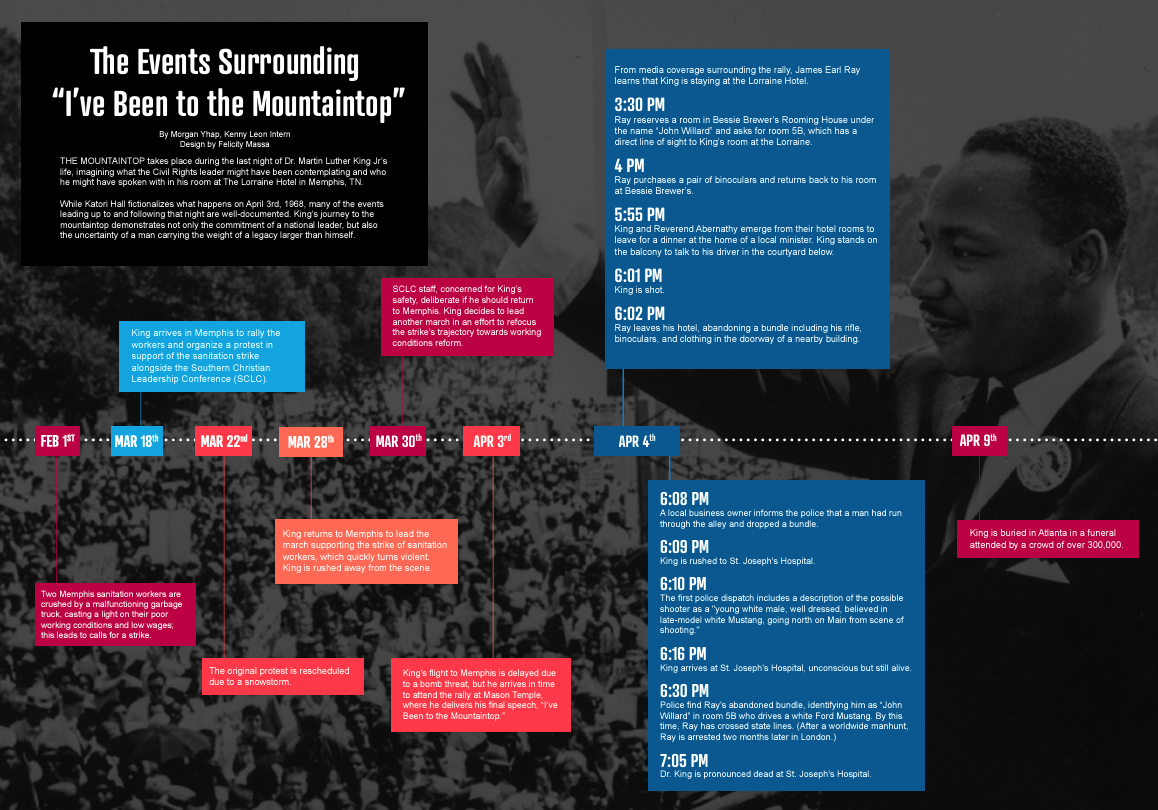
View enlarged timeline of events surrounding “I’ve Been to the Mountaintop”
The Mountaintop takes place during the last night of Dr. Martin Luther King Jr’s life, imaging what the Civil Rights Leader might have been contemplating and who he might have spoken with in his room at The Lorraine Hotel in Memphis, TN.
While Katori Hall fictionalizes what happens on April 3, 1968, many of the events leading up to and following that night are well-documented. King’s journey to the mountaintop demonstrates not only the commitment of a national leader, but also the uncertainty of a man carrying the weight of a legacy larger than himself.
February 1
Two Memphis sanitation workers are crushed by a malfunctioning garbage truck, casting a light on their poor working conditions and low wages; this leads to calls for a strike.
March 18
King arrives in Memphis to rally the workers and organize a protest in support of the sanitation strike alongside the Southern Christian Leadership Conference (SCLC).
March 22
The original protest is rescheduled due to a snowstorm.
March 28
King returns to Memphis to lead the march supporting the strike of sanitation workers, which quickly turns violent. King is rushed away from the scene.
March 30
SCLC staff, concerned for King’s safety, deliberate if he should return to Memphis. King decides to lead another march in an effort to refocus the strike’s trajectory towards working conditions reform.
April 3
King’s flight to Memphis is delayed due to a bomb threat, but he arrives in time to attend the rally at Mason Temple, where he delivers his final speech, “I’ve Been to the Mountaintop.”
April 4
From media coverage surrounding the rally, James Earl Ray learns that King is staying at the Lorraine Hotel.
3:30 pm
Ray reserves a room in Bessie Brewer’s Rooming House under the name “John Willard” and asks for room 5B, which has a direct line of sight to King’s room at the Lorraine.
4:00 pm
Ray purchases a pair of binoculars and returns back to his room at Bessie Brewer’s.
5:55 pm
King and Reverend Abernathy emerge from their hotel rooms to leave for a dinner at the home of a local minister. King stands on the balcony to talk to his driver in the courtyard below.
6:01 pm
King is shot.
6:02 pm
Ray leaves his hotel, abandoning a bundle including his rifle, binoculars, and clothing in the doorway of a nearby building.
6:08 pm
A local business owner informs the police that a man had run through the alley and dropped a bundle.
6:09 pm
King is rushed to St. Joseph’s Hospital.
6:10 pm
The first police dispatch includes a description of the possible shooter as a “young white male, well dressed, believed in late-model white Mustang, going north on Main from scene of shooting.”
6:16 pm
King arrives at St. Joseph’s Hospital, unconscious but still alive.
6:30 pm
Police find Ray’s abandoned bundle, identifying him as “John Willard” in room 5B who drives a white Ford Mustang. By this time, Ray has crossed state lines. (After a worldwide manhunt, Ray is arrested two months later in London.)
7:05 pm
Dr. King is pronounced dead at St. Joseph’s Hospital.
April 9
King is buried in Atlanta in a funeral attended by a crowd of over 300,000.

Cast featuring Keiko Agena (left) and Rex Lee (right).
The Alliance Theatre is excited to announce the cast and creative team of its upcoming production, THE CHINESE LADY. The production marks the return of Playwright & Pulitzer Prize finalist Lloyd Suh (Bina’s Six Apples) to the Alliance and welcomes Director Jess McLeod.
Inspired by the true story of Afong Moy, The Chinese Lady is a darkly poetic, yet whimsical portrait of our past seen through the eyes of a young Chinese woman. Afong – thought to be the first Chinese woman to step foot on U.S. soil – is only 14 years old when she’s brought to the United States in 1834 and put on display as “The Chinese Lady.” Decade after decade, she performs as a living exhibit, showing curious white visitors how she eats, what she wears, and how she walks on tiny bound feet. As time wears on, the lines between her performance and her identity begin to blur. Described as “moving and often sharply funny” (The New York Times), The Chinese Lady examines the ongoing struggle for empathy and understanding across cultural divides.
“The Chinese Lady is deeply rooted in history and is concerned with a young person navigating the tumult of history towards a sense of self-actualization,” said Playwright Lloyd Suh. “When I first heard about Afong Moy, her story haunted me. Afterwards, I did a deep dive to find out as much as I could about her, because I needed to understand her story even just on a personal level.”
The Chinese Lady features actors Keiko Agena (TV: Gilmore Girls) as Afong Moy, and Rex Lee (TV: Entourage and Fresh Off the Boat) as Atung. Understudies for this production include Akasha Grace and Terence Lee.
The creative team of The Chinese Lady includes Director Jess McLeod, Playwright Lloyd Suh (Alliance Theatre: Bina’s Six Apples), Set Designer Se Hyun Oh, Costume Designer, Dramaturg, and Cultural Consultant Hahnji Jang, Lighting Designer Lee Fiskness, Sound Designer Megumi Katayama, and Composer Fan Zhang.
Additional production support is provided by Stage Manager Xiaonan Chloe Liu, Stage Management Production Assistant Myah Harper, and Production Management Lead Haylee Scott.
“Not only does the historical record completely ignore Afong Moy, but there is absolutely nothing on record that comes from her point of view. The real Afong Moy is completely unknowable,” added Suh. “It’s a play that allows – even requires – an audience to respond personally. My hope is that everyone has a personal reaction [that resonates with] their own personal history, their social location, their relationship with all of what came before and especially what is happening in the world on the particular day they might experience it.”
Learn more about The Chinese Lady.
Today, the Woodruff Arts Center kicked off its $67 million capital campaign Experience Atlanta, Experience Woodruff with a groundbreaking ceremony for two additional spaces: the Goizueta Stage for Youth & Families and PNC PlaySpace.
Experience Atlanta, Experience Woodruff will bring new life to campus, expand access to proven educational programming, and secure the Woodruff Arts Center’s place as Atlanta’s center for the arts. Housed in the reimagined Rich Theatre, the Goizueta Stage for Youth & Families will be a transformative space for Atlanta’s youngest patrons, featuring thoughtfully curated programming by the Alliance Theatre and Atlanta Symphony Orchestra.
“We are thrilled to support the Goizueta Stage for Youth & Families and continue the deep relationship that my father, Roberto C. Goizueta, had with the Woodruff Arts Center during his lifetime,” said Olga Goizueta Rawls, Chairman and CEO at The Goizueta Foundation. “The Woodruff Arts Center has a long history of excellent programming for children and families and the Stage will only enhance this programming for all children in the future.”
Open six days a week, the PNC PlaySpace will be an experiential learning center where children can enjoy free play, interactive performances, and the chance to create, move, and make believe— all at no cost to families. Funding for the PNC PlaySpace is made possible through the PNC Foundation, in alignment with PNC’s signature philanthropic initiative, PNC Grow Up Great®, an early childhood education initiative now in its 20th year. The Woodruff Arts Center has collaborated with PNC Grow Up Great for 10 years, positively impacting thousands of children in the Atlanta metro area during that time.
“For more than a decade, PNC has worked to improve the quality of life in metro Atlanta through investments in high quality early education and the arts,” said Eddie Meyers, PNC Regional President for Georgia. “Our continued support of the Woodruff Arts Center demonstrates a long- term commitment to promoting a strong, vibrant arts community and a lifelong love of learning in Atlanta’s children.”
In addition to the Goizueta Stage for Youth & Families and PNC PlaySpace, capital renovations include the creation of a dynamic, outdoor community green space, lighting enhancements, clear signage, and infrastructure upgrades. Construction begins in mid-August, with the spaces set to open January 2026.
“We’re so grateful to our donors who are making this work possible,” said Hala Moddelmog, President and CEO of the Woodruff Arts Center. “Because of their generosity, we’re able to foster a more inclusive and accessible community space that invites patrons from all walks of life to spend more time with us and experience the arts in new and personal ways.”
Concurrent to Experience Atlanta, Experience Woodruff, the Alliance Theatre has launched the Imagine Campaign, establishing a $10 million endowment fund exclusively dedicated to sustaining theatrical programming and removing access barriers such as ticket and transportation costs for young audiences of all backgrounds in the new Goizueta Stage for Youth & Families.
“The Goizueta Stage and PNC PlaySpace will make it plain that youth and families are not just welcomed at the Woodruff Arts Center, but that the entire front of the building was designed specifically with them in mind,” said Christopher Moses, Jennings Hertz Artistic Director at the Alliance Theatre. “Because of these dedicated youth and family spaces, families and educators will be able to consistently rely on us as a resource for life-changing artistic experiences. We will no longer need to ask the busiest people in our community (parents of young children and educators) to rearrange their schedules to conform to our production calendars; we will instead make these experiences easily accessible to all of Atlanta.”
“It is exciting to imagine people from all over Georgia coming here to hear and make music in this flexible, intimate, and state-of-the-art space,” said Jennifer Barlament, Executive Director at the Atlanta Symphony Orchestra. “This opens up a whole new world of possibilities for the Atlanta Symphony Orchestra to serve more people in new and creative ways.”
“Curating a creative environment accessible to everyone from the moment they arrive on our campus is important to us, and these vital improvements will make each visitor’s experience that much better,” said Rand Suffolk, director of the High. “Not only do these updates signal an investment in world-class art and architecture, but they’ll also help preserve the largest item in our collection: the museum itself.”
Learn more or be a part of Experience Atlanta, Experience Woodruff.
Learn more or be a part of the Imagine Campaign.

Playwright Katori Hall
When Katori Hall began writing the first draft of what is now THE MOUNTAINTOP, America, as she saw it, stood on the verge of possibility and promise.
It was around the time that former President Barack Obama was in the Senate and about to run for the presidency. There was a feeling, she said, that America was finally going to cross over into a new chapter.
“I wrote it from a place of skepticism. As a young African American who grew up in the South, who grew up in Memphis, Tennessee, specifically, which is the place that Dr. [Martin Luther] King, [Jr.] was slain, I had questions,” she said. “I embarked on a journey of talking to my mother, talking about history, engaging with history, and dreaming about a new future.”
As a young artist at the time, her biggest questions investigated the history of America, what she called the virus of racism, and whether the country had arrived at the proverbial Promised Land.
“When he became the president, history may have been made but we were also exposed to how really racist America is,” she added. “It was almost as if people got more emboldened.”
It has been 15 years since the first performance of The Mountaintop and 13 years since its Broadway premiere at the Bernard B. Jacobs Theatre. In that time, we have experienced a great many historic moments. However, in some respects, many of the ills of the world continue to plague us – with some seemingly getting worse.
“It always seems like in America we take two steps forward and 10 steps back,” said Hall.
Which is why producing The Mountaintop in Atlanta during this election year feels timely. As our time and attention is being accosted by political ads, political stunts, and chaotic debates – literally and figuratively – The Mountaintop not only entertains us but allows us the opportunity to reflect and be inspired to act on behalf of ourselves and others.
Described as a gripping reimagining of events the night before the assassination of civil rights leader Dr. Martin Luther King Jr., The Mountaintop invites audiences to consider the person of King in ways we have never been granted permission to consider before. Hall remembers one time during its time on Broadway when a group of people walked out of the theater in a fury.
“They walked out so fast, they almost knocked off my ponytail,” she said. “The conceit of this play…the fantastical approach allows for there to be some room for a kind of deconstructing of his image – not his legacy, but his image. And I think that’s important to be able to humanize those that we have placed on pedestals. It allows us ‘ordinary people’ to find the extraordinariness in ourselves, bringing King out of the clouds, off a pedestal, making him flesh and bone and blood instead of a statue. It is what, to me, makes him more relatable, makes him more accessible, and therefore makes the things that he did, the things he achieved, more accessible and, quite frankly, more likely for us regular, degular human beings.”
Which is why she believes the play has resonated with audiences for so long. It is a story, a very specific story, about a very specific man, at a specific moment in time.
“That’s so universal,” she said. “It’s a never-ending story of how we as human beings strive for perfection. The play is as much about embracing your imperfection and pushing past our imperfections to achieve our purpose on this earth.”
And sometimes that means ruffling feathers, which Hall believes is her responsibility as a Black artist and content creator. King was special, she said, but he was also human.
“He did things that people don’t want to admit. And I think that’s okay,” she said. “[There] is burden and responsibility, [as Black artists], placed upon our shoulders [when] inheriting a history about our people. I don’t think of art as a burden, but I do think it’s my responsibility, as a good artist, to reflect reality, truth, and the hard [stuff]. I want to create difficult conversations. Why are we doing this if we’re not willing to be bold and brave and transform people by exposing them to reality?”
Not only is it never-ending in a relatable sense, but also in how it’s written. Hall intentionally wrote the play without a clear and solid ending.
“It is a play that I have never really finished because I can’t finish it. I’ll never be able to finish it because time is what it is,” she said. “At the end Camae does their roll call – this happened, this happened, this happened – so I only listed what has happened in my lifetime; what I have witnessed. Whoever produces it, whoever directs it, can add on because there’s always the most to talk about. There’s always going to be more that happens. So, [it’s written] to make sure that it’s never ending.”
The past, she said, is very present.
“I’m a reminder and a challenger and a poker, and I think even though [this] work was first produced in 2009 and now we are in 2024,” she adds. “It is still relevant. I want to always, no matter what I’m doing, challenge and create difficult conversations with my work. And so, the fact that something that I started writing in 2007, premiered in 2009, and all these years later we’re still having the same conversations. It saddens me that we are still having the same difficult conversations. But the essence of this play is that we are all kings.”
There is an African proverb that Hall considers her favorite.
“I don’t know which tribe. I don’t know which country,” she said. “But it goes, ‘All stories are true.’ Obviously, this story is not true, but it is. This was a man who had the burden and the responsibility of being one of the greatest leaders that we will ever, ever, ever see. Leaders are imperfect, they are human. They make mistakes, but they also moved mountains, and he truly, truly sacrificed time and his life to push a country forward that was not ready for progress. It takes the king and all of us, not just one person, but all of us to make it to this promised land that is so close and yet so far away.”
Performances of The Mountaintop will take place on the Coca-Cola Stage, August 30 – September 22, 2024.

Artist-in-Residence and Playwright Pearl Cleage
In the simplest of terms, SOMETHING MOVING: A MEDITATION ON MAYNARD explores the historic election of Maynard Jackson, Atlanta’s first Black mayor. But quite honestly, it’s about much more.
“Maynard changed my life,” says Pearl Cleage, the Alliance Theatre’s Artist-in-Residence and playwright of Something Moving. “I had been raised in a radical, Black Nationalist family and went to Howard University in the mid 60s when we were protesting everything. When I came to Atlanta in 1969, Maynard was running for vice mayor.”
She happened to see him on television and thought he was incredible.
“He was saying all the things I wanted a politician to say. Just a big charismatic presence,” she remembers, adding that she asked the person sitting next to her at the time, “Who is that guy?”
Their response?
“’Oh, he’s going to be the mayor!’ There was such a feeling that he was going to move everything we had fought so hard for forward,” Cleage says. “We all understood how lucky we were to have somebody like that ‘moving things’ forward. He was so in love with this city and that love exuded it in every single thing that he did.”
In that moment, she decided she would keep her eyes and ears open to everything he did. And she did.
“I’m sure I broke all journalistic objective rules,” she says.
When he launched his campaign for mayor, Cleage, who was producing a public affairs show for one of the local television stations, offered to write him a campaign speech. The speech led to her becoming the campaign’s press secretary. Her time as the campaign’s press secretary led to her becoming the Director of Communications for two years during his time in City Hall.
From that vantage point, as a member of Jackson’s inner circle, Cleage writes SOMETHING MOVING.
Because of Maynard, she not only learned Atlanta but learned to love Atlanta.
“I learned to love Atlanta the way he loved Atlanta,” she says. “Which is through the people. To be right there when people are mad that their trash didn’t get picked up or the water wasn’t on, or whatever it is. These are not big philosophical issues to people, but part of people’s daily lives. It was exhausting and exhilarating, and life changing and life affirming because you knew the work you were doing meant something.”
Cleage sets the play in present-day Atlanta. Through the voices of nine characters representing a diverse mix of identities called citizens, audiences are taken back to that time 50 years ago. In thinking about these citizens, it was important to her that they represent Atlanta. It is 2024, not 1973, after all.
“By casting Black folks and white folks, Asian people and Latinos and Native Americans, and all of the people who are part of that story, even if they’re not lifted up every time, we can see that the community we’re talking about isn’t just a small community,” she says. “It’s a big community. It’s what Atlanta looks like now. And Atlanta right now looks like America.”
We tend to think of Atlanta still in terms of Black and while, says Cleage, but Atlanta is such a diverse place.
“We talk so often about Black and white, Black and white, because we’re in the deep South. We’re in a former slave state, and we’ve never really dealt with that as a state,” she says. “We haven’t really settled all of those issues, which is evident even today in the modern political discourse.”
She reflects to after apartheid ended in South Africa. As part of their move forward, the country organized truth and reconciliation commissions where citizens would have open dialogue about the effect of apartheid on society. The conversations were not had just with the victims, but the perpetrators as well.
“Bishop Desmond Tutu, who was a big force behind the reconciliation commissions, would say, ‘We can’t move forward until we find a language to talk about the past, so we can sit in a room with each other,’” says Cleage.
That’s why, as a writer, she is so fascinated with the power of language. She watched her father, as a very charismatic minister, use language to move people and help them understand very sophisticated concepts while also moving them emotionally. That’s what she’s always trying to do in her plays — make the ideas resonate but resonate in a way where everybody can understand it.
“That’s what I want. I want us to feel that way, and I want everybody who comes in to feel that way, you know. I want everyone to feel that we are a thing of beauty – as flawed and crazy as we are as human beings – we really are a thing of beauty and infinite possibilities. And if we get together, it’s just incredible what we can do.”
There’s an exchange in the play where one of the citizens says early on, “Well, wait a minute now, this is the Mayor Jackson story, right?” And another character, known as The Witness, says, “Well, not really, you know, we start with him and all that, but it’s really about…it’s not about him.” The woman responds, “Well, what is it about?” And The Witness says, “It’s about you. It’s about me. It’s about us.”
That’s why, at its core, SOMETHING MOVING is a love letter to Atlanta. Cleage hopes this play does that as well – allow people to say, we – as in the City of Atlanta and its inhabitants — are more beautiful than we thought we were.
“That’s exactly what it is,” says Cleage. “A love letter is supposed to not only make you think about the beloved, but also see how that person sees you. When we receive one, we are like, ‘Wow, he’s writing me a letter like this or she’s writing me a letter like this. That means that I must look better than I thought I looked.’ If someone can see all that in me, I must be okay.”
Performances of Pearl Cleage’s Something Moving: A Meditation on Maynard will take place on the Hertz Stage, August 2–11, 2024.